Colour guide
Chihuahua colours, and the merle honesty most sellers skip
One of the most colourful breeds there is, with no colour ranked above another. The full range, the 'rare colour' myth, and the ethical single-merle line we hold.
Nelson and Kim, Curious Tails · AVS licence AS24J00046· Updated 24 July 2026
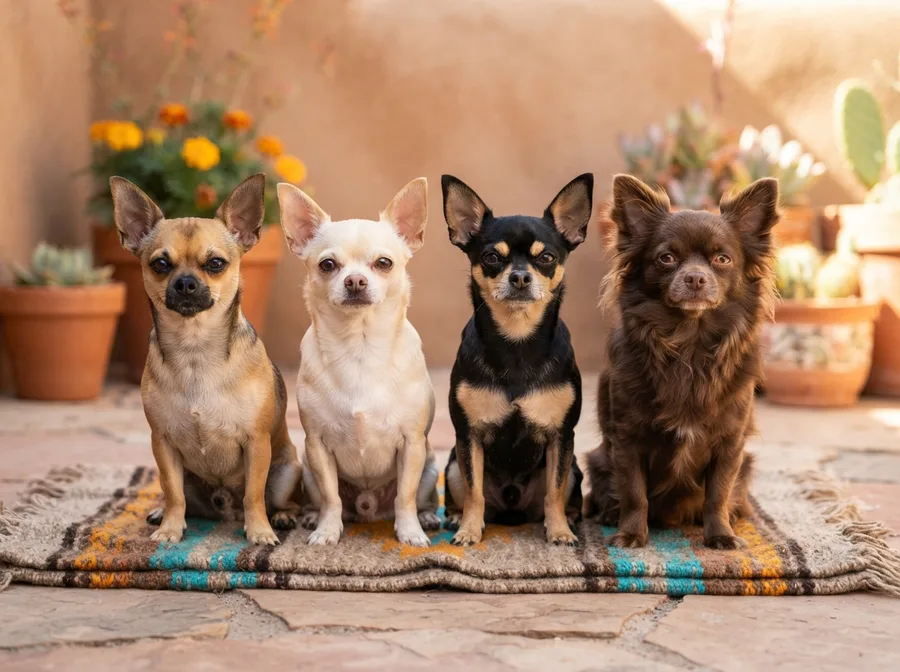
What colours do Chihuahuas come in, and do rare ones cost more?
Chihuahuas come in almost every colour, fawn, cream, white, black and tan, chocolate, blue, and patterns like sable and brindle. With us, none carries a premium. We occasionally place merle, but only from an ethical single-merle pairing with a health screening, and we never produce a double-merle, which risks deafness and blindness. Colour has no bearing on temperament, size or health, so choose the coat you love.
A rainbow of a breed, with no colour ranked above another
Few breeds come in as many colours as the Chihuahua. The breed standard is famously permissive, allowing almost any colour and pattern, which is part of why the breed is so visually varied. You will see fawn in every shade from pale sand to deep red, cream, white, black and tan, chocolate and chocolate and tan, blue-grey, and patterns like sable, brindle, spotted and particolour.
Here is our one firm rule about all of it: no colour is worth more than another. We place every colour in one price band, and we treat "rare colour" pitches as exactly that, a pitch. A blue Chihuahua is not a finer dog than a fawn one; it is a fawn one's littermate in a different coat. Colour is a preference and nothing more, and certainly not a pricing lever.
Below we walk through the popular colours, the two that attract marketing hype (blue and merle), and the one genuine ethics-and-health conversation the breed requires.
The common colours
- Fawn (pale sand to deep red)
- Cream and white
- Black and tan
- Chocolate and chocolate & tan
- Blue (a dilute grey)
- Sable, brindle, spotted, particolour
Blue, chocolate and the "rare colour" story
Two colours get dressed up as premium: chocolate and, especially, blue. Blue is not a true blue at all, it is a dilution of black to a soft slate-grey, and because it is a bit less common, some sellers slap a premium on it. We do not. A blue Chihuahua is lovely and entirely normal, and it costs the same as any other with us.
There is one small, honest health footnote worth knowing about dilute colours like blue: a minority of dilute dogs can develop colour dilution alopecia, a coat condition causing thinning or patchy fur, usually cosmetic rather than serious. It is not a reason to avoid a blue Chihuahua, but it is a reason not to pay extra for one, since you are being charged more for a colour that carries a mild extra risk, the same backwards logic as the teacup premium.
The takeaway on colour is simple: buy the shade you love because you love it. It has no bearing on temperament, size or overall health. There is no markings pattern that makes a better pet, and no solid or particolour that makes a worse one.
A "rare colour" premium is just the teacup trick in a different coat: paying more for a story, not a better dog.
Merle: beautiful, and the one real ethics conversation
Merle, a mottled, marbled pattern, is the one colour that involves genuine ethics rather than just marketing. It is striking, and it is also the pattern most abused in the breed, so here is exactly where we stand.
Merle is caused by a dominant gene. Bred responsibly, a single-merle pairing, one merle parent bred to a solid, non-merle parent, produces healthy merle puppies with no elevated risk from the pattern itself. We occasionally place merle Chihuahuas, and when we do, they come only from such a pairing and every one has a proper health screening.
What we will never do is produce or place a double-merle, the result of breeding two merle parents together. That pairing carries serious, well-documented risks of deafness and eye defects, including blindness, and it exists only because double-merles can be sold as "rare" white or heavily-marbled dogs. It is the clearest line in the breed, and we are firmly on the responsible side of it: single-merle only, health-screened, and never a double-merle.
Buying a merle Chihuahua safely
- Ask which parent is merle: only one should be
- Walk away from any "merle to merle" or double-merle litter
- Expect a health screening, especially hearing and eyes
- Never pay a rare-colour premium for the pattern
- Buy from a licensed shop that will explain the pairing
Colour and the rest of the dog
It is worth saying plainly because the market muddies it: colour has essentially no link to temperament, trainability or size. A black-and-tan Chihuahua is not bolder than a cream one; a chocolate is not calmer than a fawn. Those traits come from breeding for health and from your socialisation, not from the coat.
Colour can shift a little as a puppy matures, sables darken or lighten, and some coats develop richer markings with age, so the eight-week photo is a guide rather than a guarantee. If a precise adult colour matters to you, ask about the parents and expect a little natural drift.
And the same one-price rule runs through everything: no premium for blue, none for merle, none for a fashionable pattern. We would rather be the shop that prices the dog, not the coat.
What we place, and how to choose
We place the full natural colour range, weighted to whatever the current litters bring, and we occasionally have an ethically-bred, health-screened merle. Every colour sits in the same band, and we will always tell you honestly what a puppy is and how its colour may settle.
Choose colour last, genuinely. Pick your Chihuahua on health, temperament and the connection you feel with a particular puppy, and let colour be the tie-breaker rather than the headline. Buyers who choose that way are the happiest a year on, because they chose a dog, not a coat.
Tell us the colours you are drawn to on WhatsApp at +65 8220 6408 and we will show you what is available, merle included when we have one, always at one honest price.
Keep exploring
Frequently asked questions
What colours do Chihuahuas come in?
Almost any: fawn in many shades, cream, white, black and tan, chocolate, blue (a dilute grey), plus patterns like sable, brindle, spotted and particolour. The breed standard is very permissive on colour.
Do rare colours cost more?
Not with us. Blue, chocolate and merle all sit in the same price band as fawn or cream. A rare-colour premium is a marketing story, not a better dog, and often the colour carries a mild extra risk rather than a benefit.
What is a blue Chihuahua?
A dilution of black to a soft slate-grey. It is normal and attractive, and it costs the same as any colour with us. A minority of dilute dogs can develop mild colour dilution alopecia, which is a reason not to pay extra, not a reason to avoid one.
Do you place merle Chihuahuas?
Occasionally, and only from a health-screened single-merle pairing, one merle parent bred to a solid parent. Those puppies are healthy and carry no premium. We never breed or place a double-merle.
Why is a double-merle dangerous?
Breeding two merle parents together carries serious, documented risks of deafness and eye defects, including blindness. It exists only to sell "rare" dogs, and we refuse it entirely. Always check that only one parent of a merle litter is merle.
Does colour affect a Chihuahua's health or temperament?
No. Colour has essentially no link to temperament, trainability or size. Those come from breeding for health and from socialisation. Choose the coat you love; it says nothing about the dog inside it.
Can a Chihuahua change colour as it grows?
A little. Sables can darken or lighten and markings can enrich with age, so the puppy photo is a guide, not a guarantee. If exact adult colour matters, ask about the parents.
Meet your Chihuahua
Come say hello at Balestier
2 Balestier Road #01-701, Singapore 320002 · Weekdays 12pm–6pm · Weekends 10am–6pm. Or message us first: tell us about your home and routine, and we'll tell you honestly if a Chihuahua fits.
Still deciding?
Read the price guide first: every dollar explained, no surprises at the shop.
See the price guide