Health & dental
Why a Chihuahua needs a harness, not a collar
A Chihuahua’s windpipe is about as wide as a drinking straw. A lead on the throat pulls straight on it. Here is the harness rule, the cough to watch for, and how to fit it right.
Nelson and Kim, Curious Tails · AVS licence AS24J00046· Updated 24 July 2026
Should a Chihuahua wear a harness or a collar?
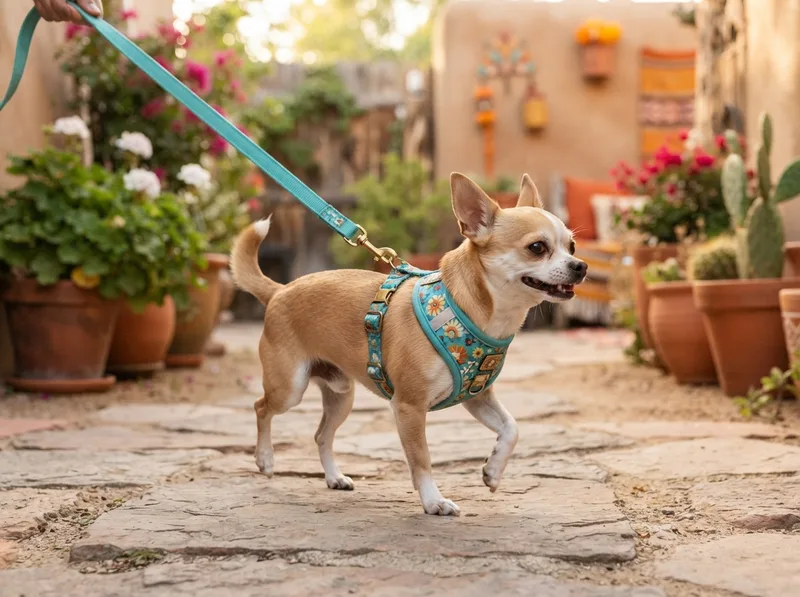
A harness, always, for walking. A Chihuahua's windpipe is very narrow with delicate cartilage, so a lead clipped to a neck collar pulls straight on the throat and aggravates the risk of tracheal collapse. A body harness spreads the load across the chest instead. Keep a collar for an ID tag if you like, but never attach the lead to it. Watch for a honking cough and see your vet if you hear one.
Why the windpipe rule matters for this breed
A Chihuahua’s windpipe, the trachea, is about as wide as a drinking straw, and the rings of cartilage that hold it open are delicate in small dogs. That is the whole reason this breed should walk in a harness and not a neck collar. When a lead attaches to a collar, every pull, lunge or correction lands directly on that fragile throat.
The condition owners are guarding against is tracheal collapse, a small-breed weakness where the windpipe flattens instead of staying round, narrowing the airway. Chihuahuas and other toy breeds are among the most affected. Pressure on the neck from a collar does not create the whole problem on its own, but it aggravates an already vulnerable airway, and it is completely avoidable.
So the rule is simple and it is not fussy or precious: for daily walking, a Chihuahua wears a body harness, and the lead clips to the harness, never to a collar around the throat. Keep a collar if you like for its identity tag, but do not attach the lead to it. This one habit protects the airway for the dog’s whole long life.
It is worth stressing that this is not a rule only for older or already-poorly dogs. Start a puppy in a harness from its very first walks and it grows up never knowing the pull of a lead on its neck, which is exactly what you want. Buying a harness instead of a walking collar costs the same money and takes the same five minutes, so there is genuinely no reason to do it the riskier way. Treat the harness as standard kit for the breed, the way you treat a bowl or a bed.
How a lead on the throat actually does harm
Picture the mechanics. A Chihuahua sees a cat, a leaf, another dog, and lunges. On a collar, the full force of that lunge, plus your instinctive tug back, is delivered straight into the soft tissue and cartilage of the neck. Do that day after day, year after year, and you are repeatedly stressing the exact structure that is already weak in the breed.
The classic warning sign is a honking cough, a dry, harsh, goose-like noise that often shows up during or just after excitement, drinking, or pressure on the neck. It is unmistakable once you have heard it, and it is the airway telling you it is irritated. A cough like that is a reason to see your vet and to double-check that nothing is pulling on the throat.
A collar also concentrates all its force on a narrow band, whereas the point of a harness is to spread the load. That is why a harness is gentler even on a perfectly healthy Chihuahua, and why it is the sensible default rather than a special measure only for dogs that already cough. Prevention here costs nothing and asks nothing.
The honking cough: when to see your vet
- A dry, harsh, goose-honk cough, often during excitement or drinking
- Coughing that appears or worsens with any pressure on the neck
- Gagging, retching, or getting winded easily on walks
- Any of the above is a reason for a vet check, and to stop clipping the lead to a collar
Choosing and fitting the right harness
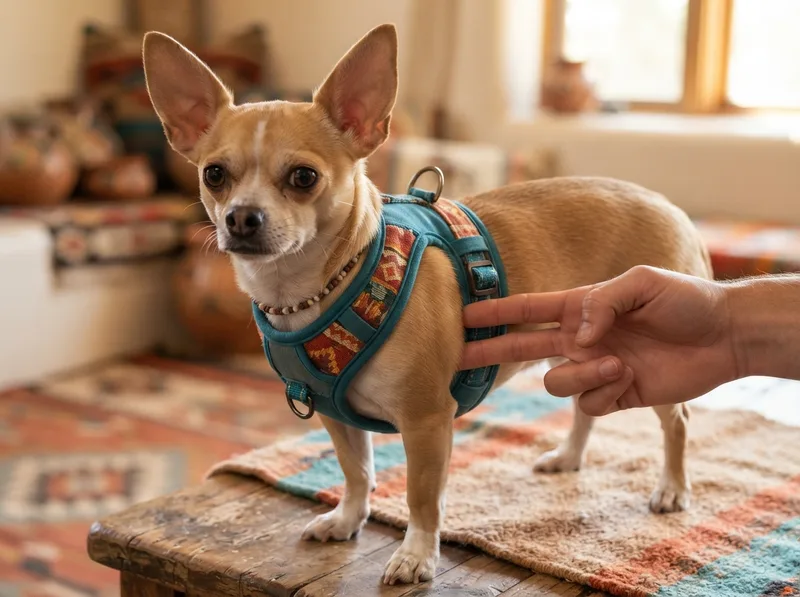
Two designs suit a Chihuahua well. A Y-harness sits in a Y-shape across the chest, leaving the shoulders free to move and keeping all pressure well away from the throat; it is the choice many owners and trainers prefer for daily walking. A step-in harness, which the dog steps into and you clip on the back, is quick to put on and good for a wriggly dog that dislikes things going over its head.
Fit is where a harness earns its keep. It should be snug but not tight: aim for two fingers to slide flat under any strap. Too loose and a bold little Chihuahua can back straight out of it on the street, which is a real safety risk; too tight and it chafes behind the front legs. Because this breed comes in a wide range of tiny sizes, measure the chest girth rather than guessing, and expect to size a puppy up more than once as it grows.
Skip the aversive gear entirely. Choke chains, slip leads and prong collars all work by pressure on the neck and have no place on a dog with a straw-width windpipe. A soft, well-fitted body harness and a light lead is the whole kit this breed needs.
Getting the harness right
- Choose a Y-harness (shoulders free) or a step-in harness (no over-the-head fuss)
- Fit snug, not tight: two fingers flat under any strap
- Too loose and a Chihuahua can back out of it, a real safety risk
- Measure chest girth; re-check the fit as a puppy grows
- Never a choke chain, slip lead or prong collar on this breed
The outlook, and how to make walks easy
The reassuring part is the outlook. Tracheal collapse and airway irritation carry a good prognosis when they are managed early and proactively. Your vet is the one to frame the outlook for your own dog. Most Chihuahuas that walk in a harness, stay at a lean weight, and avoid smoke and neck pressure go through life without the issue ever becoming a daily problem. This is very much a manageable breed trait, not a looming disaster.
Keeping walks calm helps the airway too. A Chihuahua that has learned not to lunge and choke against the lead is doing its own trachea a favour, so a little loose-lead training pays off twice. Keep sessions short and unhurried, especially on warm afternoons or in the dry chill of heavy air-conditioning, both of which can make any small dog cough more.
Put together, the message is easy to live with: harness not collar, a lean dog, calm walks, and a vet check if you ever hear that honking cough. Do those and the windpipe simply stops being something you think about. If you are setting up for a new puppy and want help picking a first harness and getting the fit right, WhatsApp us at +65 8220 6408 and we will point you to what works for a tiny chest.
A collar around the throat pulls on a windpipe as wide as a straw. Clip the lead to a harness instead.
Harness
not a neck collar
Two fingers
under any strap
Honking cough
the sign to watch
Good
outlook when managed early

Keep exploring
Frequently asked questions
Why should a Chihuahua wear a harness instead of a collar?
Because the breed has a very narrow windpipe with delicate cartilage. A lead clipped to a neck collar puts every pull straight onto the throat and aggravates the airway. A body harness spreads the load across the chest and keeps pressure off the trachea.
What is tracheal collapse?
It is a small-breed weakness where the windpipe flattens instead of staying round, narrowing the airway. Chihuahuas are among the most affected breeds. Neck pressure from a collar does not cause it alone but does aggravate an already vulnerable airway.
What is the honking cough?
A dry, harsh, goose-honk sounding cough that often appears during excitement, drinking, or when something presses on the neck. It is the airway signalling irritation and is a reason to see your vet and to stop clipping the lead to a collar.
What kind of harness is best for a Chihuahua?
A Y-harness keeps pressure off the throat and leaves the shoulders free, which many owners prefer for daily walks. A step-in harness is quick to fit and good for a dog that dislikes things over its head. Both keep the lead off the neck.
How should a Chihuahua harness fit?
Snug but not tight, with room to slide two fingers flat under any strap. Too loose and a bold Chihuahua can back out of it on the street; too tight and it chafes. Measure the chest girth and re-check the fit as a puppy grows.
Can I still put a collar on my Chihuahua?
Yes, for holding an identity tag. Just do not attach the lead to it. Keep the collar for ID and clip the lead to the harness for every walk.
Is tracheal collapse a death sentence?
No. It carries a good prognosis when managed early and proactively. A Chihuahua that walks in a harness, stays lean, and avoids neck pressure and smoke usually goes through life without it becoming a daily problem. It is a manageable breed trait.
Meet your Chihuahua
Come say hello at Balestier
2 Balestier Road #01-701, Singapore 320002 · Weekdays 12pm–6pm · Weekends 10am–6pm. Or message us first: tell us about your home and routine, and we'll tell you honestly if a Chihuahua fits.
Still deciding?
Read the price guide first: every dollar explained, no surprises at the shop.
See the price guide