Size guide
Chihuahua size and weight, with the teacup honesty built in
A healthy adult is about 1.8 to 2.7 kilograms. The standard caps size but sets no floor, which is exactly the gap teacup marketing exploits. Here are the real numbers.
Nelson and Kim, Curious Tails · AVS licence AS24J00046· Updated 24 July 2026
How big does a Chihuahua get?
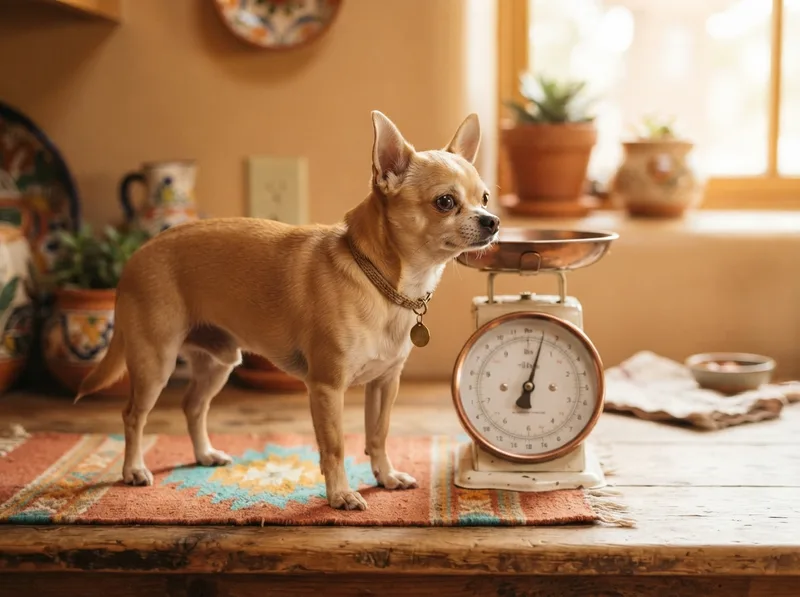
A healthy adult Chihuahua weighs about 1.8 to 2.7 kilograms (four to six pounds) and stands roughly 15 to 23 cm tall, usually full grown by nine to twelve months. The breed standard caps weight at six pounds but sets no minimum, so there is no official "teacup" size. Going below the healthy range is a risk, not a prize. Buy a standard, healthy Chihuahua and small comes free; then keep it at a lean weight you can feel the ribs through.
How big a Chihuahua really gets
A healthy adult Chihuahua weighs roughly 1.8 to 2.7 kilograms, around four to six pounds, and stands about 15 to 23 centimetres at the shoulder. That is the honest size range, and it is already tiny: a full-grown Chihuahua fits comfortably on a lap, in a carrier, or curled in the crook of your arm.
The breed standard is unusual in that it caps weight but does not set a floor. The Chihuahua Club of America and the AKC describe a dog that should not exceed six pounds, and, crucially, the standard does not classify the breed by size below that. There is no official "toy", "miniature" or "teacup" tier. There is just one Chihuahua, with an upper weight limit and a lot of natural variation underneath it.
That single fact is the key to buying one sensibly, because it is exactly the gap that "teacup" marketing exploits. Understanding the real numbers protects you from paying more for less dog.
The real numbers
- Healthy adult weight: ~1.8–2.7 kg (4–6 lb)
- Height: ~15–23 cm at the shoulder
- Standard: should not exceed 6 lb
- No official floor, no "teacup" tier
- Full grown by roughly 9–12 months
- Males and females similar; individuals vary widely
Why "smaller than standard" is a risk, not a prize
Here is the size honesty this breed badly needs. Because the standard sets no minimum, some sellers race to the bottom, breeding the smallest to the smallest and marketing the result as a premium "teacup". But going below the healthy range is not an upgrade. A one-to-two-pound adult is not a finer Chihuahua; it is a more fragile one.
Dogs bred or selected for extreme smallness carry higher risks of dangerous blood-sugar crashes, delicate bones that fracture from a jump off the sofa, crowded teeth, and a windpipe and skull that were never meant to be shrunk further. The too small end of the range is where the emergencies live. That is why a responsible shop places dogs in the healthy band and refuses to chase the label.
The reassuring flip side: you do not need to gamble on a "teacup" to get a genuinely tiny dog. A standard, healthy Chihuahua at the smaller end of normal, say two kilograms, is already about as small as a robust dog can safely be. Buy health, and small comes free.
Size red flags when buying
- A seller quoting a "guaranteed" tiny adult weight
- A premium price attached to the word teacup, micro or pocket
- Adult weight promises below the healthy 1.8 kg range
- No willingness to show the parents' sizes
Growth and estimating adult size
Chihuahuas do most of their growing in the first six months and are usually full grown by nine to twelve months, though some fill out a little longer. A rough rule of thumb owners use is that adult weight lands somewhere around double the puppy's weight at about twelve to sixteen weeks, but treat that as a guide, not a guarantee, since growth varies with the individual and the parents.
The most reliable predictor is not a formula, it is the parents. A good shop will tell you the sire and dam sizes, and a puppy usually lands within that family range. Anyone offering a precise "will stay under two pounds" promise is selling certainty they do not have, and often steering you toward the risky small end on purpose.
The apple head and deer head shapes do not meaningfully change adult weight, and the difference between males and females is small and swamped by individual variation. Head type and sex are about preference; size is about genetics and, above all, healthy feeding.
The size that matters most: lean
Once your Chihuahua is grown, the single most important number is not how small it is but how lean it is. On a two-to-three kilogram dog, body condition matters enormously: even a couple of hundred grams of excess is proportionally huge and lands straight on the knees, windpipe and heart.
Use the hands-on test rather than the scale alone. You should be able to feel the ribs easily under a thin layer of covering, see a waist when you look down from above, and see a tuck-up when you look from the side. If the ribs are hard to find, your Chihuahua is carrying too much, and a small dog hides weight well under a coat and a convincing stare.
A lean weight is the cheapest health insurance the breed has, and it is far more within your control than the adult size the genes deliver. Measure food, count treats in the daily total, and resist the table scraps. A lean Chihuahua of standard size will, on the evidence, out-live and out-thrive a tiny "teacup" every time.
1.8–2.7 kg
healthy adult weight
≤ 6 lb
the standard cap
9–12 mo
full grown
Feel the ribs
the lean test
What we place, and how to ask about size
We place Chihuahuas in the healthy size range, and we will tell you the parents' sizes and give you an honest expected range for a puppy rather than a marketing promise. We will not quote a "guaranteed teacup" weight, because doing so would mean either lying or breeding for fragility, and we do neither.
When you shop anywhere, ask three questions: what do the parents weigh, what is the honest expected adult range for this puppy, and what does the shop do about feeding and hypoglycemia in the early months. The answers separate a responsible seller from a size-marketer instantly.
Want a genuinely small, genuinely healthy Chihuahua without the teacup gamble? WhatsApp us at +65 8220 6408 and we will talk you through the real sizes of what is available and what each puppy is likely to grow into.
The standard caps how big a Chihuahua should be, not how small. "Smaller" is not a grade above the standard. It is a risk below it.
Keep exploring
Frequently asked questions
How big do Chihuahuas get?
A healthy adult Chihuahua weighs about 1.8 to 2.7 kilograms (4 to 6 pounds) and stands roughly 15 to 23 centimetres at the shoulder. That is already very small, a genuine lap dog.
What does the breed standard say about size?
It caps weight at no more than six pounds and, unusually, does not classify the breed by size below that. There is no official toy, miniature or teacup tier, just one Chihuahua with an upper limit.
Is a smaller Chihuahua better?
No. Below the healthy range, smaller means more fragile: higher risks of hypoglycemia, bone fractures, dental crowding and airway problems. A standard Chihuahua at the smaller end of normal is already about as small as is safe.
When is a Chihuahua full grown?
Usually by nine to twelve months, with most growth done by six months. A rough guide is that adult weight is around double the weight at twelve to sixteen weeks, but the parents' sizes are the most reliable predictor.
How do I tell if my Chihuahua is a healthy weight?
Use your hands: you should feel the ribs easily under a thin covering, see a waist from above and a tuck-up from the side. On such a small dog even a little excess is a lot, so measure food and count treats.
Do males and females differ in size?
Only slightly, and individual variation swamps the average. Head type does not meaningfully change adult weight either. Size is mostly genetics plus healthy feeding.
Is a two-pound Chihuahua healthy?
Usually it is at the risky end. Adults below the healthy 1.8 kilogram range tend to be the fragile "teacup" dogs, with more emergencies and often shorter lives. We place dogs in the healthy band and avoid the extreme small end.
Meet your Chihuahua
Come say hello at Balestier
2 Balestier Road #01-701, Singapore 320002 · Weekdays 12pm–6pm · Weekends 10am–6pm. Or message us first: tell us about your home and routine, and we'll tell you honestly if a Chihuahua fits.
Still deciding?
Read the price guide first: every dollar explained, no surprises at the shop.
See the price guide